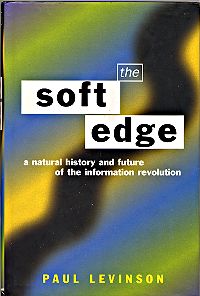
 P. Levinson
Routledge, London, 1997
P. Levinson
Routledge, London, 1997
ISBN 0415157854 (boards)
Buy it from Amazon.com
Buy it from Amazon.co.uk
Any book that can discuss how Gutenberg's printing press helped Erasmus' reformation to become 'the first successful heresy against the Church in a thousand years', in the same breath as Darwin and Asimov, at least looks promisingly eclectic.
The Soft Edge is a wild rambling argument, a tour through Levinson's habitat, the familiar yet bizarre world of media. The author confesses to 'a liking for weeds': his book illustrates his passion, as the theme is not so much followed as diverged from, like a creeper steadily enveloping a wall in all directions at once.
To venture a summary, the media have always come under attack from critics who argue that each innovation is destroying something precious. This 'Greek Chorus' indeed includes its founding father, Socrates, who claimed that writing weakened the memory, and the tradition of remembered poetry. And so it did; but as Levinson points out - the debate continuing after 2000 years! - Socrates' own words would long since have slipped into oblivion, but for the power of the written medium. If the book has a thesis, it is that (page 105)
"No one would deny that … information technologies have powerful effects on our lives. What is open to question - and what I specifically dispute - is how damaging such effects might be, especially on our capacity to provide remedies in the form of new technologies."
Here we have Levinson's triple theme: critics assert media are harmful; he denies it; and in any case, other media can remedy most of the damage. The fourth, invisible theme, is naturally that media are rich, diverse, fascinating, human, endlessly new, and a proper subject of study.
The idea of a medium as a remedy is intriguing. This is a subtle, second-order effect: first, a medium, which solves one problem, creates another. A second medium, perhaps a variant of the first, solves the second problem… an infinite regress is apparent. For example, writing "severed [the] relationship" between meeting a person and communicating with them, between "talking and walking". The loss of personal contact "was the price paid for [the] enormous powers of extension across space and time" of the written media, "the alphabet and the printing press". Levinson goes on
"But … this created a deep need for media that repaired the breach, while maintaining the benefits of print's extension. Photography began part of the repair."
In other words, the posted photograph partially heals the gap created by the sending of a letter instead of a personal visit. Of course, telephone, 2-way radio, and interactive video are other steps in the same direction, all 'remedial media'.
Weaknesses in some of the arguments are inevitable in so vast a project. He is strongest on his home patch, media in the 20th Century, and most vulnerable at the edges of his coverage. For example, systems engineering is certainly far bigger than making 'computers' easier to use. Again, do we have to agree that Akhnaton failed to promote his sun-god (where the God of the Hebrews succeeded) merely because Egyptian hieroglyphics were inferior to the Hebrew alphabetic script?
Very occasionally one can catch him in a definite error, as when he asserts that radio tends always to be controlled by government:
"even in the democratic United Kingdom, broadcasting came under the control of the BBC, a government agency far more powerful than the FCC in America, and able to easily control the broadcast of information so as to be favorable to the government in power, as in the case of Margaret Thatcher and the Falklands War."
Now this is one of Levinson's hobby horses (he references his own 1989 article on the subject). I can remember what happened in the Falklands War, and there are two relevant facts. Firstly, it is true that information from the front was tightly controlled, but it was by the government and not the BBC, which has no authority to control other broadcasters. Secondly, the BBC adopted so liberal a viewpoint that it was roundly castigated by Margaret Thatcher for not supporting "our boys" more clearly. The BBC's refusal to change its line demonstrated its independence exceptionally clearly. This example is curious, as Levinson certainly had ample opportunity to establish the facts. His more general point - that radio was a fine propaganda weapon in the hands of dictators - is well taken. Perhaps, through much discussion and narration, the case of the BBC and the Falklands became inverted in Levinson's mind. It is certainly hard to imagine an American agency taking such an independent line (though presidents, too, can be impeached).
So it isn't clear whether the author is always right - and ultimately it doesn't matter. The texture of Soft Edge is what the title implies, not a sharp sword but a gradual way of winning an argument. Levinson's style is to provoke, so perhaps he never intends all his arguments to be accepted at face value: I imagine the professor nettling his students into debate, tempting them to take him on, hoping to win a point or two. Just as television alternately dazzles, informs, amuses, annoys, and confuses, so the author is in his element (should I say medium?) as his prose sparkles and sputters. Like the media which he so passionately defends, Levinson does not confine himself to one mode of argument.
Perhaps the most satisfying of the book's many insights is the comprehensive demolition of Ellul's widely-claimed dehumanising effect of media, as for instance that television has made us all into passive recipients, 'couch potatoes'. The (persuasive) crux of the argument here is that media evolve, by Darwinian selection, towards 'natural' modes of communication. For example, silent movies were almost instantly superseded by talkies, as soon as the technology for integrating a soundtrack became practical. The appeal of pictures-plus-sound is that the combination is like daily life in which we see and hear the people we meet. Why then do still photography and pictureless radio continue to thrive? Because we are also familiar, runs the argument, with tranquil scenes from a window or across a landscape; most of the picture hardly ever changes. Radio mimics the world of incidental sound, experienced in nature both when we listen to the night and when we eavesdrop on someone else's conversation: radio is that most intimate of media, a whisperer. Far from being crushed by television, radio has been pushed into its true niche: it only occupied the full-attention niche while nothing better was available. Television's immediately available pictures-plus-sound tempt us to seek relationships, but the flickering ghosts it provides as tempters never satisfy, hence its addictive quality. Radio offers something altogether different. And the new media are strikingly interactive.
The Soft Edge is a fitting mirror to the complex, frustrating, and exciting world of media that Levinson guides us through. It is a powerful book, with forgivable flaws. The media - naturally - bridge the gap between the scientific/technical world and humanity, and it takes a big author to do the same. He is big enough, indeed, to slap down over-enthusiastic advocates of the new media, such as Barlow claiming that information (as on the Web) wants to be free. There is plenty of commercially, militarily, and politically sensitive information that would be worthless (or worse) if revealed to the other side. In Levinson's fine words, metaphysically free information "need not, should not, entail total economic liberation".
Anyone interested in what the new media technologies - including those not yet invented - mean for us and society will find this a thoughtful and stimulating book.
© Ian Alexander 1998, 2000