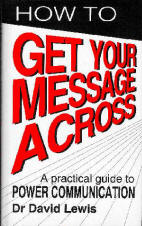
 David Lewis
Souvenir Press, 1997
ISBN 0285633481
David Lewis
Souvenir Press, 1997
ISBN 0285633481
Buy it from Amazon.com
Buy it from Amazon.co.uk
Lewis is a solid hardback of the old-fashioned self-improvement sort, in which the reader is exhorted to Address an audience confidently, to Grab and hold your audience's attention, and much more.
Visually, Lewis and his publisher clearly believe that BOLDER IS BETTER, as the cover and several of the diagrams are set in large, bold, upper-case, Swiss type for immediate knock-out effect. The book's style speaks of nervous executives rushing through busy airports to enormous meetings where they will risk being ignored by hostile audiences ("The symptoms of public speaking nerves include: rapidly beating heart; uneven breathing; dry mouth; upset stomach ...").
Lewis was trained in experimental psychology at the University of Sussex, runs his own consultancy which teaches business people about stress, communications and leadership, and has written books such as The Secret Language of Your Child.
Lewis' book presupposes a world in which the speaker and the audience are unequal. The speaker probably has at least as much power, for the duration of the speech, as the whole of the audience put together. The language is of force:
"You have to make people grasp the relevance of your message to them personally."
Lewis certainly understands enough psychology to know that the audience consists of people who have feelings. In fact, he is amusingly perceptive on this question: "WIIFM has been described as the world's most popular radio station since we are all tuned into it at every waking moment."
WIIFM stands for "What's In It For Me?", and the point is that the business speaker will have more impact if his audience quickly realize the benefit of the lecture. Lewis contrasts the laid-back attitude of airline passengers to the mandatory safety announcement on every flight, with their desire for information about where the exits and life-jackets are in an emergency. But the psychology is servant to the goal, which is making money. Lewis puts his cards on the table in the last sentence of his book, in a piece of advice which, however sensible, seems a little too convenient for his profession:
"Aim to invest at least 5 per cent of your income on self-improvement, by subscribing to magazines, journals, buying books and taking courses."
Lewis may be a useful book to the novice public speaker. It is packed with sensible tips about topics such as breathing and use of slides and flipcharts; there are helpful sections on speaking to people in other countries and cultures (never start a talk in Japan with a joke, for instance). There is a genuinely helpful index, and while some of the advice may seem pedestrian, the book is a worthy effort.
© Ian Alexander 1996